
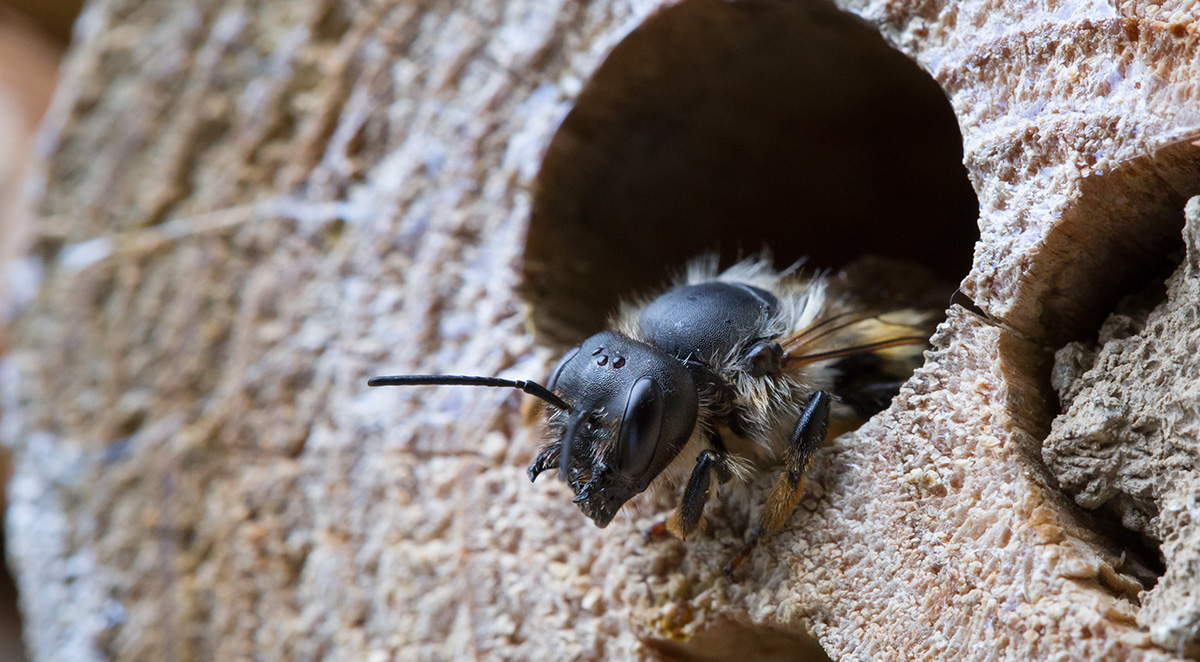
If you are seeing large, bumblebee-like insects hovering around your deck, eaves, or fence this spring, there is a good chance you are looking at carpenter bees. They show up across Indiana every year as the weather warms, and at first they seem harmless enough. A few bees buzzing around the porch is easy to ignore.
The problem is what those bees are doing to the wood. Carpenter bees drill into wooden structures to nest, and the damage builds quietly, season after season, until it becomes expensive to repair. The earlier you recognize what you are dealing with, the easier and cheaper it is to stop. Here is how to identify carpenter bees, understand the damage they cause, and decide what to do about them.
Quick Summary
- Carpenter bees are large, bumblebee-lookalike insects that drill perfectly round, half-inch holes into wood to nest, most actively in spring.
- Telltale signs include round entry holes, sawdust or yellow staining below them, bees diving repeatedly at the same spots, and woodpecker activity nearby. The damage compounds over years as bees return to and expand old galleries, woodpeckers tear into the wood hunting larvae, and moisture seeps into open holes.
- DIY sprays rarely solve the problem because they do not reach galleries or eggs or prevent return.
- Professional treatment addresses the active infestation, seals the galleries, and helps prevent new bees, while painting or staining bare wood is the best long-term prevention.
How to Identify Carpenter Bees
Carpenter bees are frequently mistaken for bumblebees because they are similar in size and coloring. Telling them apart matters, because they behave very differently and call for different responses.
Carpenter bees have a shiny, hairless black abdomen, while a bumblebee's abdomen is fuzzy and yellow. Carpenter bees are typically solitary rather than living in large colonies, and they are most active in spring when females are drilling and laying eggs. The males hover aggressively near nests and can seem intimidating, but they have no stinger. Females can sting but rarely do unless directly handled.
Carpenter Bees vs. Bumblebees
A quick way to tell which you are dealing with:
- Abdomen: Carpenter bees have a shiny, bare black abdomen. Bumblebees are fuzzy and yellow all over.
- Behavior: Carpenter bees are usually solitary and drill into wood. Bumblebees are social and nest in the ground or in cavities.
- What they do to your home: Bumblebees are pollinators that leave your structures alone. Carpenter bees bore into wood, which is where the damage comes from.
If the bee is shiny-bodied and fixated on the wood of your deck or eaves, it is almost certainly a carpenter bee.
Signs of Carpenter Bee Activity
You will often notice the signs before you get a close look at the bees themselves. Watch for these indicators around wooden structures:
- Round entry holes: Carpenter bees drill near-perfect circular holes about half an inch in diameter, often on the underside of beams, decks, railings, siding, and fascia.
- Sawdust and staining: Coarse sawdust on the ground below a hole, often accompanied by yellowish staining on the wood from bee waste.
- Repeated diving: Bees hovering and diving at the same area of your home again and again, especially males guarding a nest.
- Woodpecker activity: Woodpeckers hunt carpenter bee larvae, so persistent pecking at a specific wooden structure can be a sign that bees are nesting inside.
If you are seeing any of these, it is worth assessing the situation before nesting season is fully underway.
The Damage Carpenter Bees Cause
A single carpenter bee hole is not an emergency. The reason carpenter bees matter is that the damage compounds over time, and it does so through three separate mechanisms.
Generational Nesting
Carpenter bees are strongly drawn to wood that has been nested in before. The existing galleries and scent markings make old holes far more appealing than fresh wood, so new bees return year after year and expand the tunnels rather than starting over elsewhere. Over several seasons, what began as a single half-inch hole can become a network of tunnels stretching a foot or more into a beam.
Woodpecker Damage
This is the secondary damage that often turns out to be worse than the original. Woodpeckers are attracted to the sound and presence of carpenter bee larvae inside the wood, and they will drill and tear into the wood to reach them. The result is large, ragged openings alongside the neat bee holes, and far more visible structural damage.
Moisture Intrusion and Rot
Open holes in exterior wood let water in. Once moisture gets into a beam or board, it accelerates rot and can attract other wood-destroying insects over time. A small entry hole becomes a doorway for a much larger decay problem.
Because of how the damage compounds, early treatment is dramatically less costly than waiting until a structure needs to be repaired or replaced.
Where Carpenter Bees Strike in Indiana Homes
Carpenter bees favor bare, unfinished, or weathered softwood, and Indiana homes offer plenty of it. The most common targets include:
- Decks, railings, and deck framing
- Eaves, fascia, and soffits
- Fences and fence posts
- Wooden siding and trim
- Sheds, barns, pergolas, and other outbuildings
Lakefront and rural properties with lots of exposed wood structures, like docks, boathouses, and cabins, tend to see heavier activity, since there is simply more attractive wood available. Painted and well-sealed wood is far less appealing to carpenter bees than bare or weathered surfaces.
How to Get Rid of Carpenter Bees
Effective carpenter bee control is more than swatting bees or plugging holes, and this is where do-it-yourself efforts usually fall short.
Hardware store sprays can kill an individual bee on contact, but they do not reach the bees already inside the galleries, the eggs that have been laid deep in the wood, or the conditions that bring bees back next spring. DIY plugging also tends to fail, because sealing a hole without first treating the gallery can trap active bees that simply chew a new exit, and it does not discourage the next generation from returning to the same spot.
A professional approach addresses the whole cycle. It starts with an inspection to find all the active galleries, including ones you may not have noticed. The active galleries are then treated to eliminate the bees inside, and only after treatment are the holes sealed, which prevents new bees from reusing them and keeps moisture out. Finally, prevention recommendations target the conditions that attract bees in the first place. You can read more about our full process on our carpenter bee control page.
Preventing Carpenter Bees
Once you have dealt with an active infestation, a few steps make your home far less inviting the following spring.
- Paint or stain bare wood: This is the single most effective deterrent. Carpenter bees strongly prefer bare and weathered wood and tend to pass over painted or well-sealed surfaces.
- Seal old galleries: After treatment, filling and sealing old holes removes the scent-marked entry points that draw returning bees.
- Choose less vulnerable materials: Where practical, hardwoods and non-wood materials are less attractive than soft, untreated woods like pine and cedar.
- Treat early: The best window is early spring, when females are drilling and before eggs are laid deep in the galleries. Treatment at this stage is more effective and heads off the next generation.
Quick Do's and Don'ts
Do:
- Act early in the season, when treatment is most effective
- Paint or stain exposed wood to discourage nesting
- Have galleries professionally treated before sealing them
- Watch for woodpecker activity as an early warning sign
Don't:
- Assume a few bees now will not become a bigger problem later
- Plug holes without treating the gallery first, which can trap active bees
- Rely on contact sprays alone, since they miss eggs and galleries
- Wait until the wood is visibly damaged to take action
Frequently Asked Questions
Are carpenter bees dangerous?
Not to people, for the most part. Male carpenter bees hover aggressively but have no stinger. Females can sting but rarely do unless handled directly. The real danger is to your property, not to you.
Can I treat carpenter bees myself?
Hardware store sprays can kill individual bees, but they do not reach bees inside the galleries, eggs already laid, or the conditions that bring bees back. DIY treatment also usually skips gallery sealing, which is part of why infestations return. Professional treatment is more thorough and more cost-effective over time.
Why do carpenter bees keep coming back to the same spots?
Carpenter bees are strongly attracted to previously used nesting sites. The existing galleries and scent markings make old holes far more appealing than fresh wood, so new bees return each spring and expand the tunnels. Treating and then sealing galleries, along with finishing bare wood, is the most effective way to break the cycle.
What time of year are carpenter bees active in Indiana?
Carpenter bees are most active in spring, roughly April through June in Indiana, when females are drilling and laying eggs. You may see continued activity into summer as larvae develop, and adults overwinter in old galleries before emerging again the following spring.
Will painting or staining my wood prevent them?
It significantly reduces the risk. Carpenter bees strongly prefer bare, unfinished, or weathered wood, so painting or staining exposed surfaces is one of the most effective long-term prevention strategies, especially on decks, fences, and eaves.
Do you treat sheds, fences, and outbuildings too?
Yes. Carpenter bees will nest in any suitable wooden structure, and treatment covers decks, fences, sheds, barns, pergolas, and other outbuildings, not just the main house.
Stop the Damage Before It Spreads
Carpenter bees are easy to dismiss in spring, but the damage they cause is real and it compounds every year you leave it unaddressed. If you are seeing round holes, sawdust, or bees diving at your wood structures, the time to act is now, before nesting season is in full swing and before the next generation moves in.
Contact Sam's Pest Control for a free inspection and we will assess the activity and recommend the right course of action. We treat carpenter bees across northern Indiana, including lake and rural properties around Monticello and White County where exposed wood structures are common.
Call (219) 290-9489. Monday through Friday, 9am to 5pm. Prompt service available when you call early.