
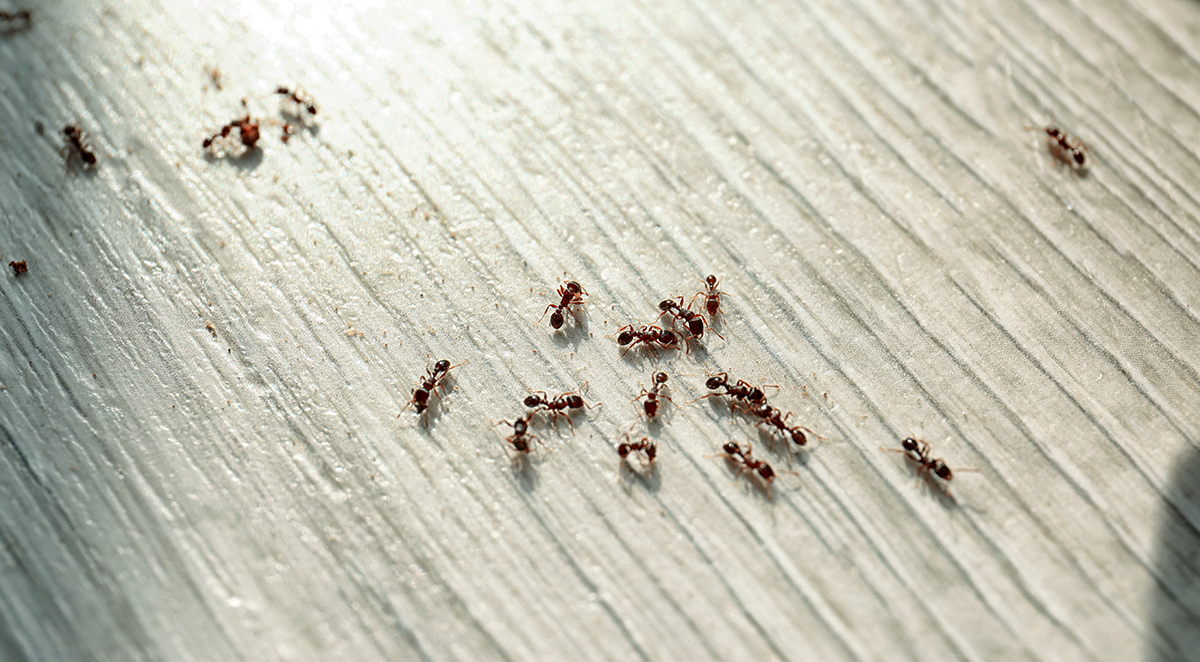
It usually starts with a single ant on the kitchen counter. Then a few more. By the next morning there is a steady trail marching from a crack near the window to the dog bowl, and you are left wondering what you did to deserve this. The answer, in most cases, is nothing. Ants in your home are not a sign that you keep a dirty house. They are a sign that summer in Indiana has arrived, and your home has something they want.
Ants are the most common pest problem Indiana homeowners face, and they peak indoors in the heat of July and August. This guide explains why they come inside, how to tell which kind you are dealing with, and what actually works to stop them, because the trail you can see is rarely the whole story.
Quick Summary
- Ants come inside Indiana homes looking for food, water, and shelter, especially during summer heat and after heavy rain.
- The most common indoor species are odorous house ants and pavement ants, which are nuisances, and carpenter ants, which can damage wood and deserve more serious attention.
- Killing the trail you can see does not solve the problem, because the colony stays hidden and keeps sending foragers.
- Effective control means identifying the species, targeting the colony rather than the trail, and sealing the entry points and conditions that drew them in.
- Good prevention, including managing food, moisture, and entry gaps, keeps them from coming back.
Why Ants Come Inside Indiana Homes
Ants are not trying to move in with you. They are foragers, and your home is simply the most rewarding place they have found to search. A few specific drivers push them indoors in Indiana, and summer turns up the pressure on all of them.
They Are Searching for Food and Water
Ants send out scouts to find food, and when one finds a reliable source, it lays down a scent trail that the rest of the colony follows. A few crumbs under the toaster, a sticky spot near the trash, or a pet bowl left out is more than enough to start a parade. Water matters just as much as food. During a dry stretch, ants will come indoors looking for moisture around sinks, dishwashers, and bathrooms, which is why kitchens and bathrooms are the most common trouble spots.
Weather Swings Drive Them Indoors
Indiana summers deliver both extremes, and both push ants inside. Stretches of intense heat and drought send them indoors hunting for water, while heavy summer rains flood their outdoor nests and force them to higher, drier ground, which often means your walls and foundation. A sudden indoor ant problem right after a big rain is one of the most common scenarios we see.
Your Home Offers Easy Entry
Ants are tiny and persistent, and they exploit the smallest openings: gaps around windows and doors, cracks in the foundation, openings where utility lines enter, and spaces under siding. This is true of new and old homes alike. A brand-new house has settling gaps and construction seams, and an older home has decades of small openings, so no home is naturally ant-proof.
Common House Ants in Indiana
Not all ants are the same, and identifying what you have matters, because the wrong treatment can actually make some problems worse. These are the species Indiana homeowners encounter most.
Odorous House Ants
Small, dark brown to black ants that give off a distinctive smell, often compared to a rotten coconut, when crushed. They love sweets and moisture and are one of the most common kitchen invaders. They form large colonies and will relocate when threatened, which is exactly why spraying the trail tends to scatter them into multiple new colonies instead of solving the problem.
Pavement Ants
Small brownish-black ants that nest under sidewalks, driveways, and foundation slabs, then forage indoors. They are not picky eaters and will go after grease, sweets, and crumbs alike. They are primarily a nuisance, but their numbers can be substantial.
Carpenter Ants
The largest ants you are likely to see indoors, usually black and noticeably bigger than the others. Unlike the nuisance ants, carpenter ants matter structurally, because they excavate wood to build their nests. They deserve their own discussion, which is next.
Carpenter Ants: When Ants Become a Structural Problem
Most ants are an annoyance. Carpenter ants are a warning sign. They do not eat wood the way termites do, but they tunnel through it to create nesting galleries, and over time that excavation can weaken the wood in your home.
Carpenter ants are drawn to wood that is already damp or compromised, so their presence often points to a moisture problem, such as a leak, poor drainage, or condensation, that has softened wood somewhere in the structure. Signs of carpenter ant activity include large black ants indoors year-round (not just in warm months), faint rustling sounds inside walls, and small piles of what looks like sawdust beneath wooden surfaces. That sawdust, called frass, is the wood they have pushed out of their galleries, often mixed with insect parts.
The most important thing carpenter ants get confused with is termites, and the two call for very different responses. Here is how they compare:
|
Feature |
Carpenter Ants |
Termites |
|
Antennae |
Bent or elbowed |
Straight and beaded |
|
Waist |
Narrow, pinched |
Broad, no visible waist |
|
Wings (swarmers) |
Front wings longer than back |
Four wings, all equal length |
|
Relationship to wood |
Tunnel through it to nest |
Eat it for food |
|
Evidence left behind |
Frass (sawdust-like piles) |
Mud tubes (subterranean termites) |
|
Color |
Usually black |
Swarmers are dark, workers pale |
If you are not certain which you are dealing with, it is worth confirming, because termites cause a different and often costlier kind of damage. Our companion guide on termite warning signs in Indiana walks through the termite side in detail, and our termite treatment and prevention page covers what to do if that is what you have.
Why DIY Ant Control Usually Fails
Most homeowners reach for a can of spray at the first trail, and it feels like it works. The ants you spray die, the trail disappears, and the problem seems solved. Then the ants are back in a few days, often somewhere new.
The reason is simple: the ants you see are a small fraction of the colony. The trail is made of foragers, and the colony, including the queen that keeps producing more ants, stays hidden in a wall, under a slab, or outside. Killing foragers does nothing to the colony. Worse, with some species like odorous house ants, spraying triggers a survival response called budding, where the colony splits and relocates into several smaller colonies. You can turn one ant problem into three.
Over-the-counter baits can help, but only if they are the right type for the species and placed where the ants actually travel. The wrong bait, or the right bait used incorrectly, gets ignored. This is why ant problems so often feel like a losing battle when handled with store products alone.
How to Actually Get Rid of Ants
Effective ant control works backward from the trail to the colony. The goal is not to kill the ants you can see but to eliminate the colony producing them.
That starts with identification. Knowing the species tells us where it nests, what it eats, and how it responds to treatment, which determines the right approach. From there, the treatment targets the colony itself, often using bait that foragers carry back to the nest and share, reaching the queen and the workers you never see. We also treat entry points and the areas where ants are traveling, and we address the conditions that invited them in.
Our residential pest control handles ants as part of comprehensive coverage, with treatment built around your specific situation rather than a one-size-fits-all spray. For homeowners dealing with recurring summer ant pressure, ongoing service keeps colonies from re-establishing season after season.
Preventing Ants: What Homeowners Can Do
Professional treatment handles an active problem, but a few habits make your home far less attractive to ants in the first place.
- Manage food sources: Store pantry items in sealed containers, wipe up crumbs and spills promptly, and avoid leaving pet food out overnight.
- Cut off water: Fix dripping faucets and leaks, address damp areas under sinks, and reduce standing water around the foundation.
- Seal entry points: Caulk gaps around windows, doors, and utility penetrations, and repair damaged weatherstripping.
- Trim vegetation: Keep shrubs, tree branches, and mulch from touching the house, since they act as bridges and harborage right against your foundation.
- Take out the trash: Keep indoor and outdoor bins clean and sealed, since they are a reliable ant magnet.
None of these guarantees an ant-free home on their own, but together they remove the food, water, and access that draw ants indoors.
Quick Do's and Don'ts
Do:
- Identify the type of ant before treating, since the right approach depends on the species
- Use bait that foragers carry back to the colony
- Address moisture and food sources that attract them
- Take large black ants seriously, since they may be carpenter ants
Don't:
- Spray every trail you see, which can scatter some species into multiple colonies
- Assume ants mean your home is dirty, because they don't
- Ignore sawdust-like piles near wood, which can signal carpenter ants
- Expect a one-time spray to solve a colony you cannot see
Frequently Asked Questions
Why do I get ants even when my house is clean?
Because ants are not looking for dirt, they are looking for food, water, and shelter. A few crumbs, a little moisture, or simply a dry spell outdoors is enough to draw them in, regardless of how clean your home is. Ants invade spotless homes all the time.
Are these ants dangerous, or just a nuisance?
Most common house ants, like odorous house ants and pavement ants, are nuisances rather than threats. Carpenter ants are the exception, because they tunnel through wood and can cause structural damage over time, and their presence often signals a hidden moisture problem.
How do I know if they're carpenter ants?
Carpenter ants are noticeably larger than typical house ants and usually black. Other clues include seeing them indoors during cooler months, faint rustling in walls, and small piles of sawdust-like frass beneath wooden surfaces. If you are seeing those signs, it is worth having them identified.
Will store-bought sprays work?
Sprays kill the ants you see, but not the hidden colony that keeps sending them, so the problem usually returns. With some species, spraying can even cause the colony to split and spread. Targeting the colony, often with the right bait, is what actually resolves an infestation.
Why do ants keep coming back?
Because the colony was never eliminated, only the visible foragers were. As long as the nest survives and the food, water, and entry points remain, ants will keep returning. Lasting control requires reaching the colony and removing what attracts them.
When is ant season worst in Indiana?
Ant activity ramps up in spring and peaks indoors during the heat of July and August, when foraging is most intense and weather extremes push ants inside. Activity often spikes after heavy summer rains flood outdoor nests.
Stop the Trail at Its Source
A trail of ants across the counter is frustrating, but it is solvable, as long as you go after the colony and not just the line of ants you can see. Identifying the species, treating the nest, and closing off what drew them in is what turns a recurring summer headache into a solved problem.
If the ants keep coming back, or you suspect you are dealing with carpenter ants, contact Sam's Pest Control and we will identify what you have and recommend the right approach. We treat ants for homeowners across northern Indiana.
Call (219) 290-9489. Monday through Friday, 9am to 5pm. Prompt service available when you call early.